

FiiO M25 Launches in AKM and R2R Versions
From: Vitor Valeri
A headphone hobbyist for over 15 years, he founded the Hi-Fi Hub website and is an administrator of the "Fones High-End" and "Fones Low-End" groups on Facebook.


Published in: 14/09/26 at 18:19 - Updated in: 30/10/26 at 20:51
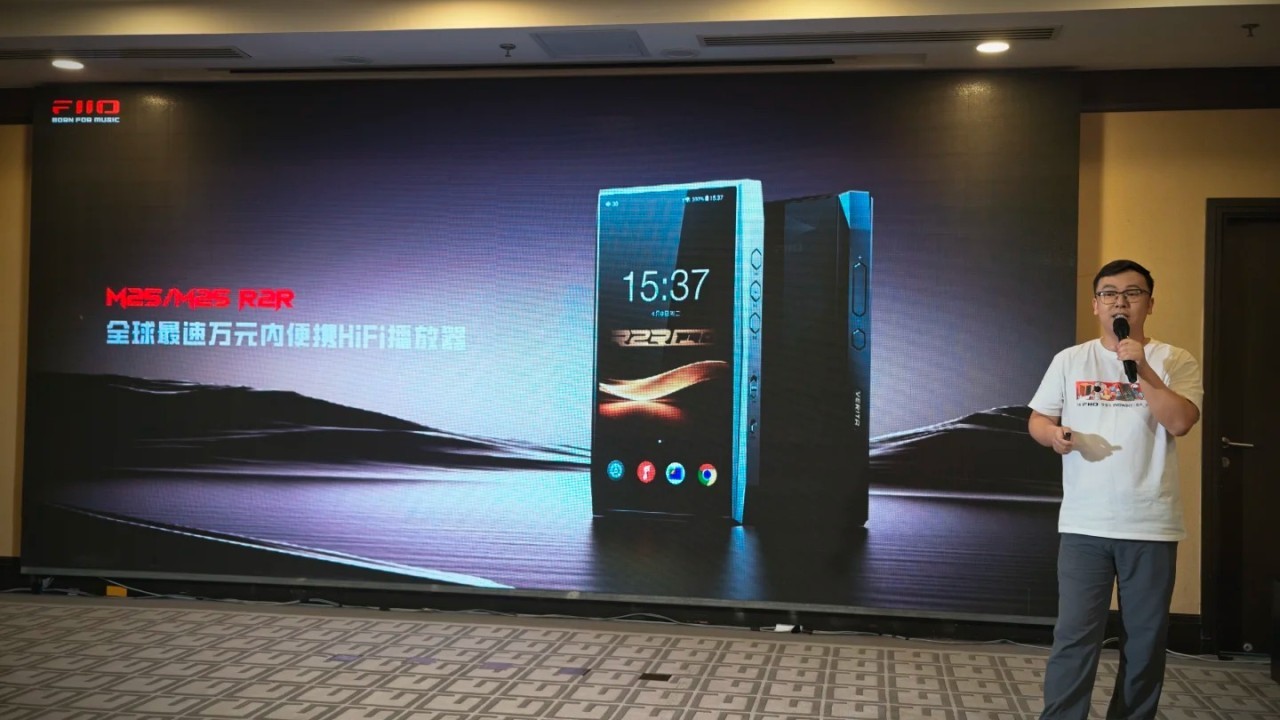 FiiO M25 being presented during the 8th Beijing International Headphone Exhibition 2026 (Image: 麦兜兜/Rednote)
The FiiO M25 was launched last Saturday (September 12) during the 8th Beijing International Headphone Exhibition 2026 in China. The M25 is the company’s sub-flagship DAP (Digital Audio Player), positioned below only the FiiO M27 and above the M33 R2R. Unlike other FiiO DAP releases, the M25 comes in two versions: VERITA and R2R PRO.
The M25 VERITA features an AKM delta-sigma DAC chip, whereas the M25 R2R PRO uses a DAC based on an R2R architecture developed in-house by FiiO. See the details below.
Update (October 30): The FiiO M25 VERITA (AKM) and FiiO M25 R2R are now available from FiiO’s official store on AliExpress.
The M25 Arrives in Two Versions with Distinct Sound Signatures
FiiO decided to release two variants of its sub-flagship DAP to accommodate different sound preferences. The difference between the M25 VERITA and the M25 R2R PRO lies not only in their DACs but also in battery life, as you will see later.
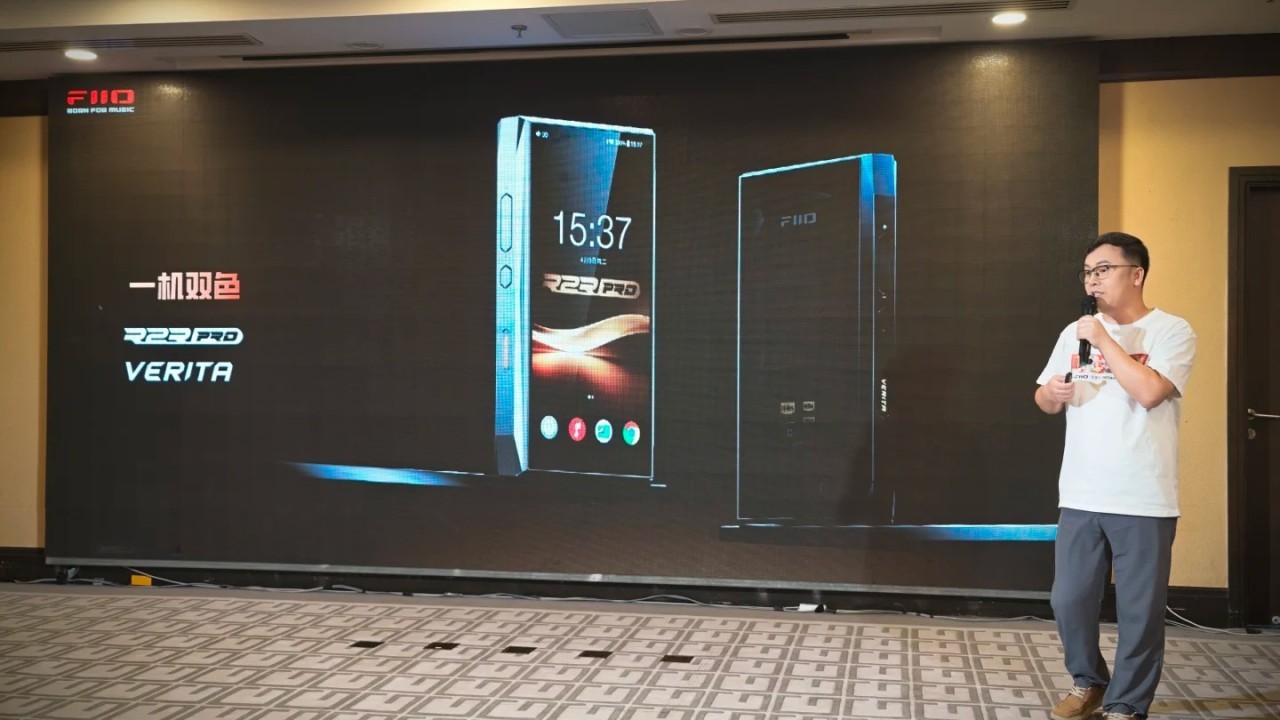
The Sound of the Two FiiO M25 Versions
The FiiO M25’s sonic characteristics evolved throughout the audio events at which the DAP was exhibited. A user on the Chinese social media platform Weibo reported the following about the two M25 versions:
“When I listened to a preproduction unit, my greatest concern was the R2R version. At the time, FiiO seemed to place excessive emphasis on sonic character: the treatment of soundstage and imaging was somewhat extreme, with a certain sense of constriction and excessively veiled treble.
In the final version, the soundstage opened up. At least in terms of width, the difference from the AKM version is not substantial, although depth is more limited. The treble has a moderate degree of viscosity, vocal density is not high, and the emphasis is on a smooth, dense presentation, with abundant detail in breathing and articulation. It is a sound with a distinct identity, yet it remains relatively balanced.”
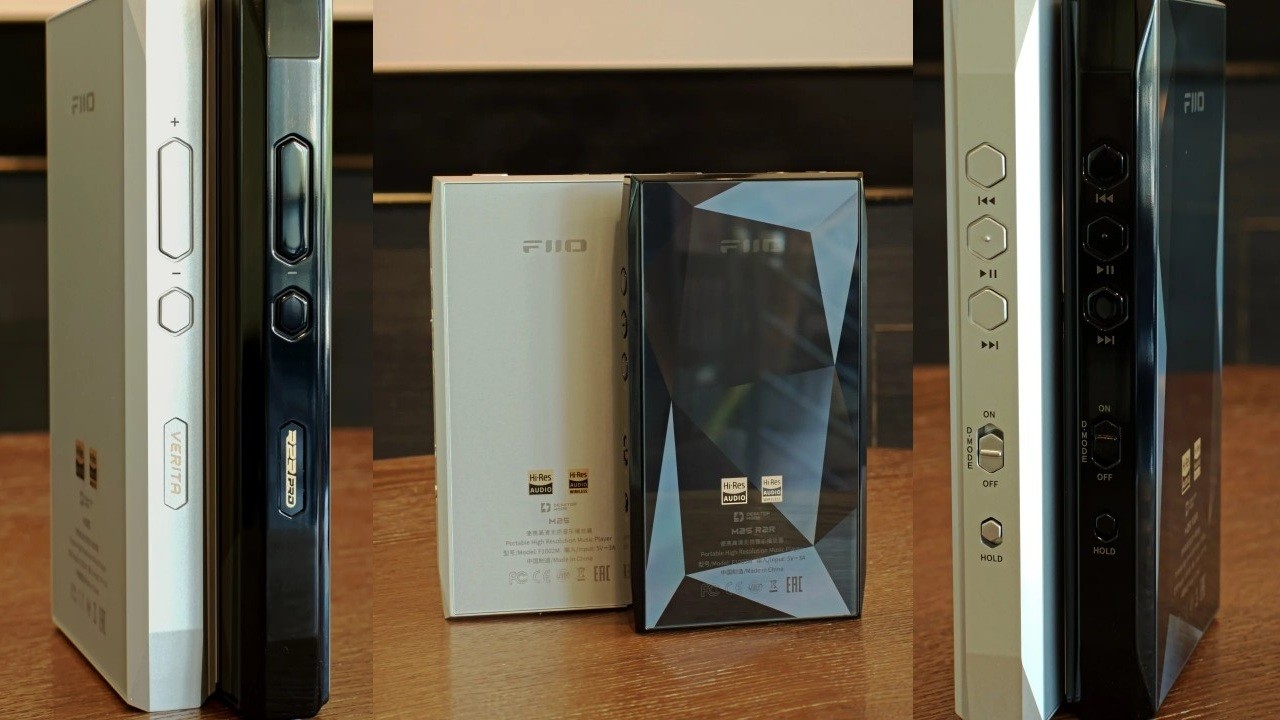
Another user shared impressions of the FiiO M25 on Rednote, stating:
“The R2R and AKM versions exhibit only subtle differences, but direct listening clearly reveals the distinctions arising from the two architectures. In terms of soundstage definition, the AKM version presents the contours of sounds more clearly, whereas the R2R version sounds more diffuse.
In the bass, the AKM version offers fast decay, strong cohesion, and good impact transients, while the R2R version’s bass is more stable and grounded. For the midrange and vocals, I personally prefer the R2R version: it is sufficiently smooth and delicate, although extended listening can even make you sleepy. The AKM version, on the other hand, presents more pronounced contours. In the treble, the AKM has a clear advantage over the R2R in brightness and incisiveness.”
Next, I will discuss the DAC hardware used in the two FiiO M25 versions to provide a better understanding of each implementation.
The DAC Chips Used in the Two FiiO M25 Versions
The DAC architectures used in the M25 VERITA and M25 R2R differ. The details of each implementation are presented below.
The R2R DAC in the FiiO M25 R2R PRO
The R2R DAC version of the M25 uses a segmented architecture in which the five most significant bits are decoded using 31 resistors with thermometer coding. This solution implemented by FiiO mitigates the accumulation of errors commonly found in conventional R2R DACs while also reducing distortion. In total, the FiiO M25 R2R PRO uses 316 high-precision, low-temperature-drift thin-film resistors.
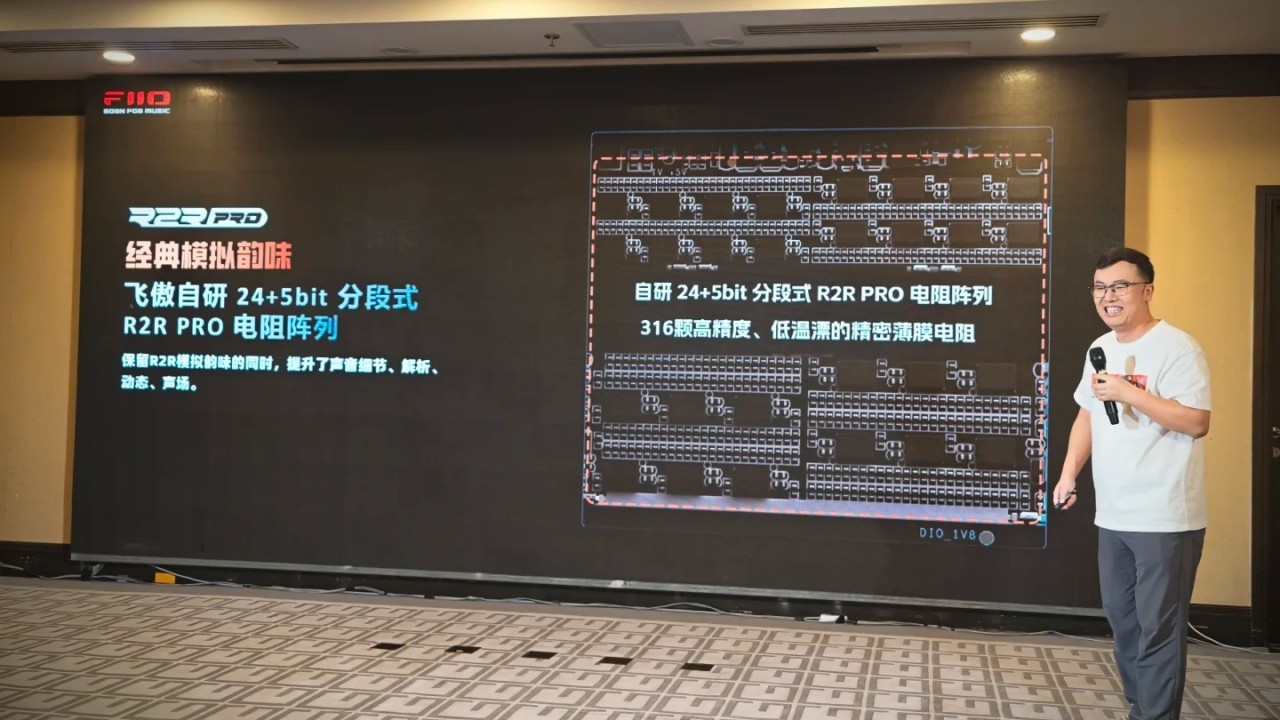
Selectable Sound Signatures on the M25 R2R PRO
In addition to its R2R DAC architecture, the M25 R2R PRO offers two selectable sound signatures:
• Natural – FLAT: “Preserves the original character of the sound, providing faithful reproduction.”
• Warm – WARM: “Maintains high resolution while adding a warm, smooth texture.”
The Delta-Sigma DAC in the FiiO M25 VERITA
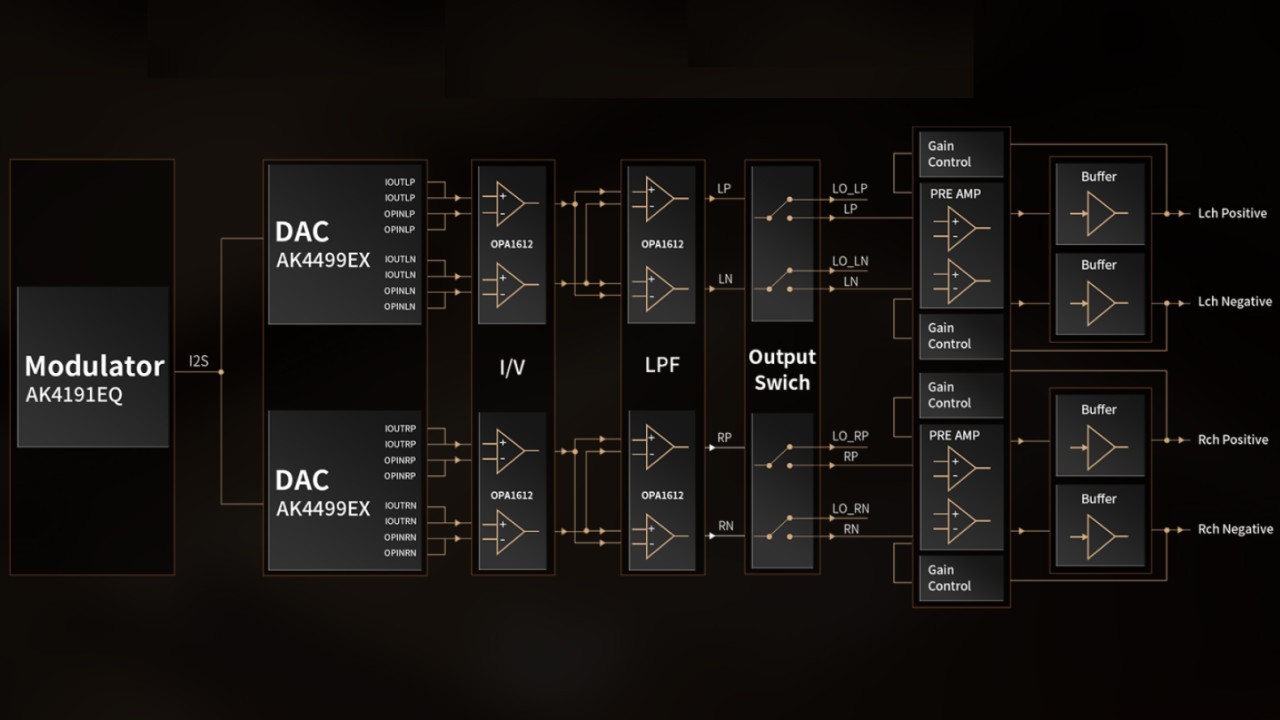
The AKM DAC version of the M25 uses two AK4499EX chips. Each chip processes one channel, reducing common-mode interference. According to FiiO, this design choice provides “better channel separation and greater dynamics.”
The M25 manufacturer explains some of the benefits of the AKM DAC models selected for the DAP:
“The architecture, based on new design techniques, completely separates the digital and analog sections and incorporates the newly developed DWA ROUTING technology. This creates a cleaner sonic background, improves resolution, increases sonic accuracy, and enhances detail reproduction.”
Multiple Exclusive AKM Sound Signatures
By choosing the M25 VERITA, you gain access to different sound signatures developed by AKM, the manufacturer of the DAC chip used in this version of FiiO’s DAP:
• Prism Horizon: Fidelity to the original sound.
• Azure Atmos: Natural atmosphere.
• Scarlet Gravity: Emotional expressiveness.
• Wild Groove: Immersive ambience.
However, excellent sound quality and multiple sound signatures are of little benefit if the navigation experience is not smooth. Below, we examine the processor used in the FiiO M25 and the amount of RAM available in the DAP.
Smooth Operation Enabled by a Snapdragon 778G–Equivalent SoC
By combining the Qualcomm QCS6490 SoC, equivalent to the Snapdragon 778G, with 8 GB of RAM, the M25 delivers highly fluid navigation. A Rednote user shared the following experience with the FiiO M25 interface:
“This time, FiiO equipped the M25 directly with the Snapdragon 778G processor. Although the M27 series had previously been caught off guard by HiBy’s “hidden trump card,” the RS82, FiiO has truly secured the title of the smoothest DAP under 10,000 yuan, approximately US$1,490.70. Taking popular streaming services as an example, from opening an app and loading the music interface to switching tracks and performing searches, the device responds noticeably faster than players in the same price range and even some more expensive models. This is my assessment after actually using it: it is exceptionally smooth.”
The FiiO M25 uses the Thundercomm TurboX C6490 module, the same module found in the brand’s flagship DAP, the M27. These modules are used in IoT (Internet of Things) solutions, but DAP manufacturers use them to implement specific commands, features, and functions. Each module includes components such as an SoC, RAM, a storage unit, and a Bluetooth antenna.
Smooth operation alone is not sufficient for a DAP, since it is not a smartphone. It is therefore important to discuss the components and solutions used to deliver high-quality audio.
Reducing Audio Noise Caused by the Power Supply
To reduce audio noise caused by the components’ power supply, the FiiO M25 uses independent power supply circuits for each section. This solution provides a cleaner sonic background and greater energy availability for audio playback.
A USB Controller Chip for Perfect Audio–Video Synchronization
When the FiiO M25 is connected to a PC, smartphone, or tablet and used as a USB DAC/amp, or “external sound card,” the XMOS XU316 chip helps maintain synchronization. This USB controller chip prevents audio and video from becoming unsynchronized in movies, television series, or games.
High-Precision Digital Signal Transmission
To ensure low jitter [1] during signal transmission, the M25 uses the same clock architecture as the M27. Both the M25 and M27 employ a high-capacity FPGA chip and two custom high-performance femtosecond crystal oscillators.
Lower jitter improves the clarity of subtle details, sonic naturalness, instrument separation, and soundstage.
[1] Jitter is the unwanted variation in the timing at which the DAC reads an audio sample. Ideally, digital audio samples should be read and converted at perfectly regular intervals.
A 31-Band Parametric Equalizer (PEQ)
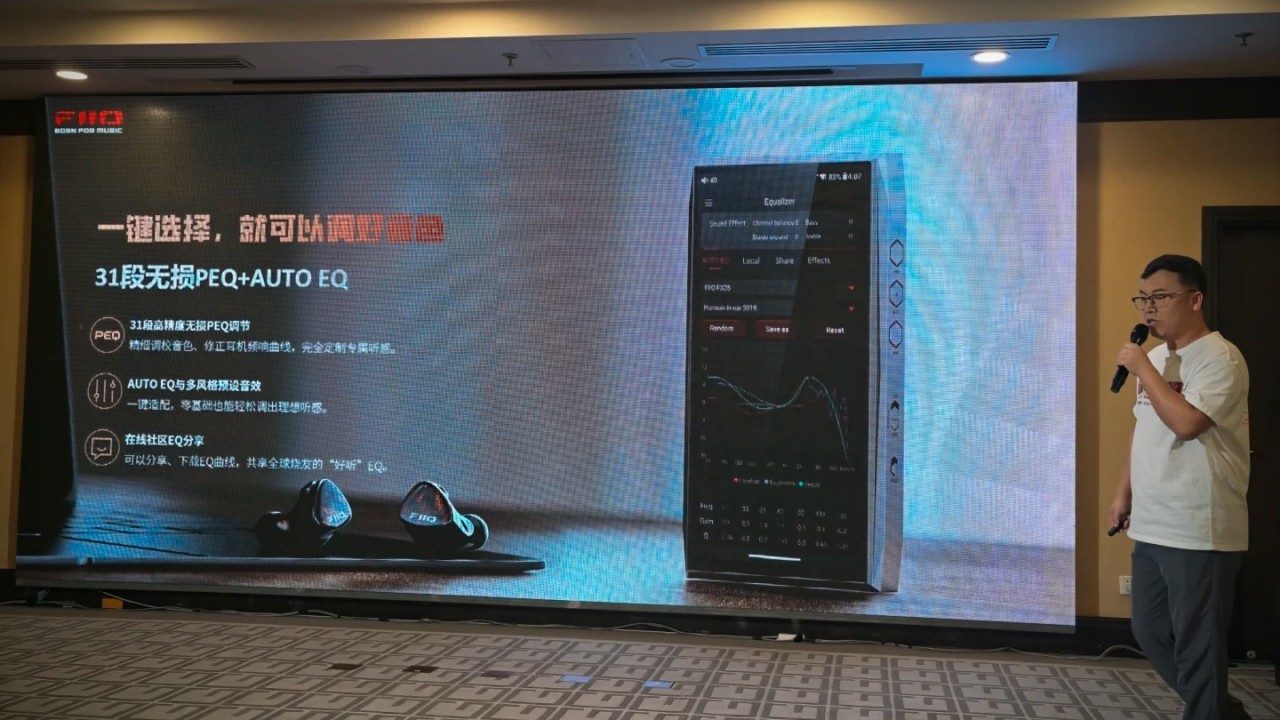
As on the M27, the Equalizer app includes a 31-band parametric equalizer (PEQ) and the “AUTO EQ” feature. A custom equalization profile is applied to all apps installed on the DAP. To simplify adjustments, “AUTO EQ” allows users to select target curves and equalization profiles based on the frequency response curves of different headphone models.
FiiO M25 Battery Life Reaches Nearly 15 Hours
The R2R PRO version of the FiiO M25 offers up to 14.5 hours of battery life when using its 3.5 mm single-ended (SE) output. The M25 VERITA, in comparison, provides up to 9.5 hours.
When using the 4.4 mm balanced output, the M25 VERITA delivers up to 8.5 hours of continuous playback. The M25 R2R PRO achieves 12.5 hours of battery life through its 4.4 mm output.
Fast Charging Support Across Multiple Protocols
The FiiO M25 battery can be recharged using different fast charging protocols. Both PD (Power Delivery) and QC (Quick Charge) are supported. The DAP supports chargers rated at up to 30 W, allowing the battery to reach 100% in approximately 2 hours and 30 minutes.
FiiO M25 Output Power Compared with the M27 and M33
When using the 4.4 mm balanced output in “desktop mode” [2] with the highest gain setting selected, the FiiO M25 delivers 1,700 mW into 32 ohms. Its maximum output power is therefore higher than that of the M33 but lower than that of the M27. The following table compares the maximum output power of these models.
| Model | FiiO M25 | FiiO M15S | FiiO M33 |
| Maximum output power | 1700mW | 1200mW | 1100mW |
[2] “Desktop mode” allows the DAP’s battery to be bypassed and increases output power across all gain levels. In addition, this mode enables the selection of a gain level beyond “High Gain.”
FiiO M25 Size and Weight Compared with Other DAPs from the Brand
Compared with the M15S, the M25 is more compact and lighter. However, compared with the M33, the M25 is heavier and larger. The table below compares the DAP models mentioned.
| Model | FiiO M25 | FiiO M15S | FiiO M33 |
| Dimensions (height x width x thickness) | 139,8 × 76 × 18 mm | 140 x 80 x 18.9mm | 138.2×71.5x17mm |
| Weight | 318g | 345g | 258g |
FiiO M25 Connections and Buttons
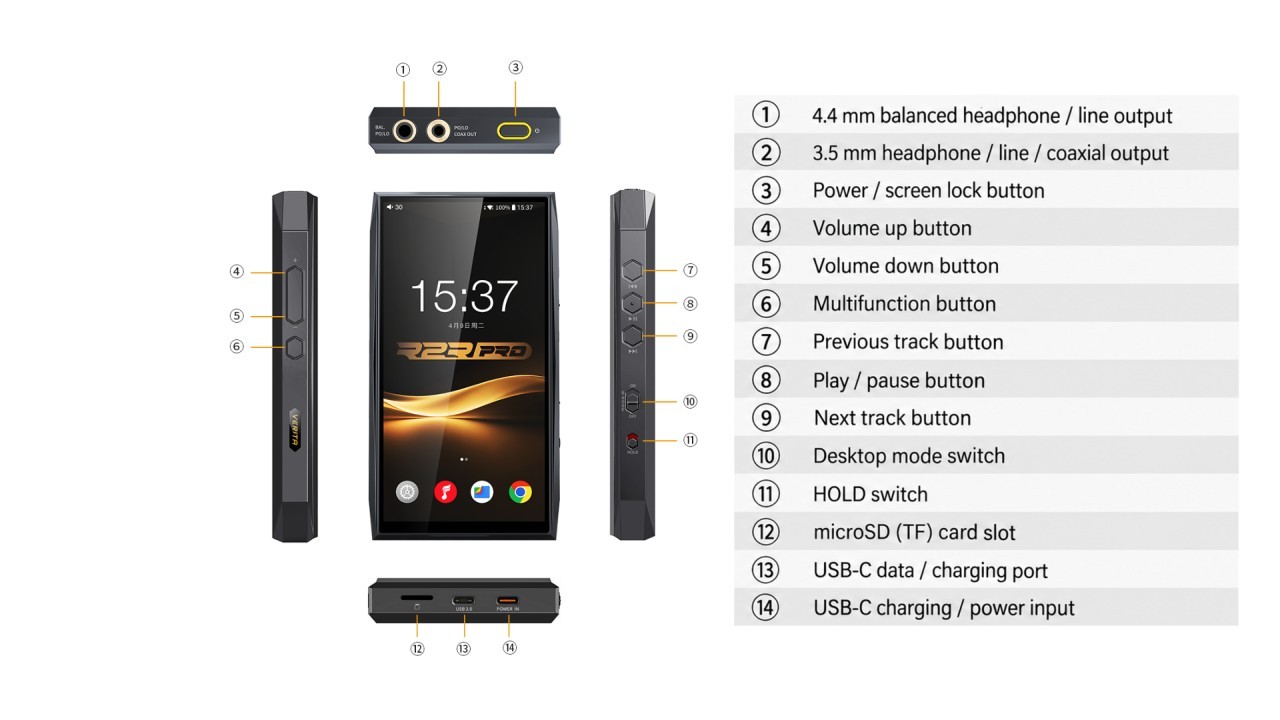
The diagram below shows the FiiO M25’s connections and buttons.
Compatible with the RETRO BOX Bluetooth Speaker
Like the JM21, M21, and M33, the FiiO M25 is also compatible with the FiiO RETRO BOX Bluetooth speaker. For more information, see this Hi-Fi Hub news article covering the RETRO BOX launch.
FiiO M25: Specifications
General Specifications
- 2.4 GHz and 5 GHz Wi-Fi
- AirPlay support
- Color: Glossy black and matte silver
- DAC chip: AKM AK4499EX for the FiiO M25 VERITA and an R2R DAC developed in-house by the manufacturer for the FiiO M25 R2R PRO
- Digital outputs: USB, Bluetooth, and coaxial via a 3.5 mm connection
- Dimensions: 139.8 × 76 × 18 mm
- Display: 5.5 inches, with a resolution of 1080 × 2160 pixels
- Double-tap-to-wake support
- Headphone outputs: 3.5 mm single-ended (SE) and 4.4 mm balanced
- Internal storage: 128 GB
- Line outputs: 3.5 mm single-ended (SE) and 4.4 mm balanced
- Memory card slot: One slot supporting microSD cards up to 2 TB
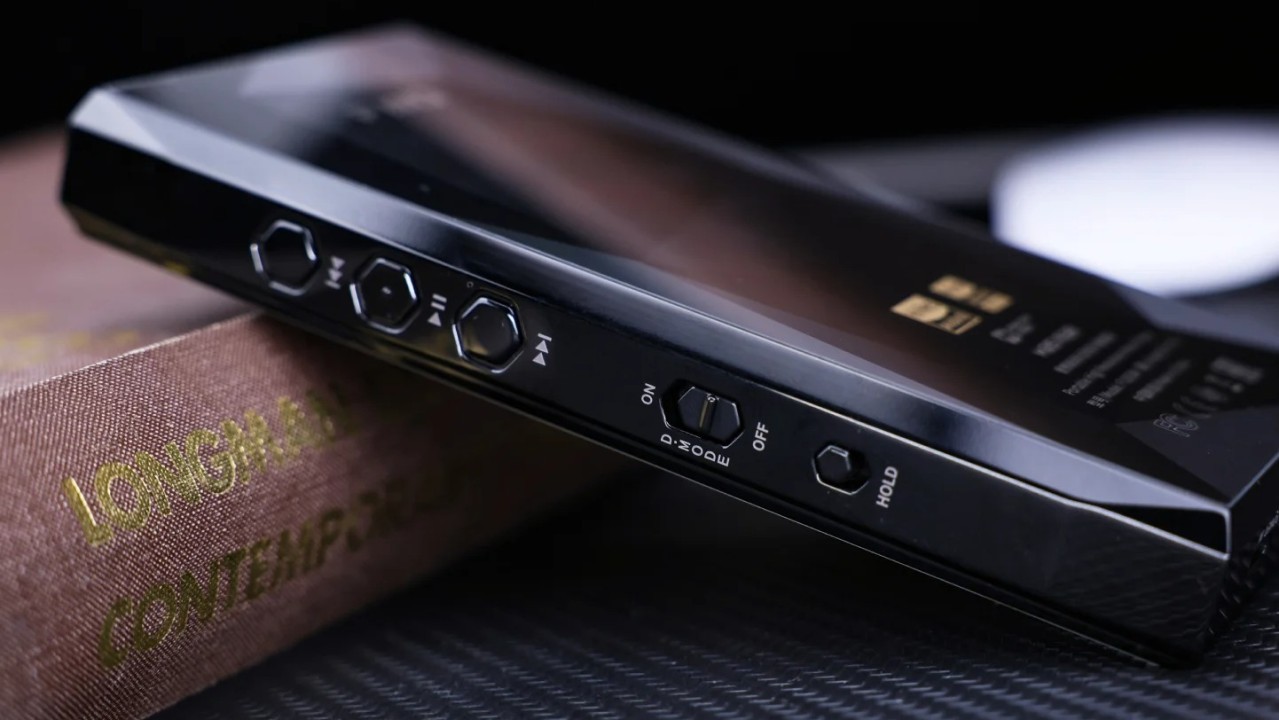
- Physical buttons: Power, volume, multifunction, play/pause, previous track, and next track
- Physical slide switches: D.MODE and HOLD
- RAM: 8 GB
- Scheduled shutdown support
- Screen rotation support
- SoC: Qualcomm QCS6490, equivalent to the Snapdragon 778G
- Support for gesture navigation, two-button navigation, and three-button navigation
- USB ports: One USB-C 3.0 port for data and charging, and one USB-C port for power and charging
- Weight: 318 g
Battery Specifications
• Battery capacity: 6,500 mAh
• Charging time: 2.5 hours with PD 3.0 PPS fast charging
• Maximum battery life: 14.5 hours for the FiiO M25 R2R PRO and 9.5 hours for the FiiO M25 VERITA
• Support for fast charging at up to 30 W
• Support for QC 3.0, QC 4.0, PD 2.0, and PD 3.0 PPS fast charging protocols
Bluetooth Specifications
• Bluetooth version: Bluetooth 5.2
• Supported Bluetooth reception codecs: SBC and LDAC
• Supported Bluetooth transmission codecs: SBC, aptX, aptX HD, aptX Adaptive, LDAC, and LHDC
General Audio Specifications
• “ALL TO DSD” support
• 31-band parametric equalizer (PEQ) with an AUTO EQ option
• Decoding in USB DAC mode: 768 kHz/32-bit; native DSD512
• Decoding via the coaxial output: 384 kHz/24-bit; DSD128 via DoP
• Decoding via USB audio: 768 kHz/32-bit; DSD512, with support for DoP, D2P, and Native
• MQA: System-wide decoding
• Native decoding on the DAP: 768 kHz/32-bit; native DSD512
• Supported audio formats: DSD (DSD64, DSD128, DSD256, and DSD512; .iso, .dsf, and .dff files; DST ISO), DXD, APE Fast/High/Normal, APE Extra High, APE Insane, ALAC, AIFF, FLAC, WAV, WMA Lossless, MP3, OGG, WMA, and other formats
3.5 mm Single-Ended (SE) Output Specifications
| Parameter | Low Gain | Medium Gain | High Gain | Headphone Mode |
| Distortion + noise – PCM | 0,006% (1 kHz / 0 dB, at 32 Ω) | 0,005% (1 kHz / −5 dB, at 32 Ω) | 0,005% (1 kHz / −4 dB, at 32 Ω) | 0,005% (1 kHz / −3 dB, at 32 Ω) |
| Distortion + noise – DSD | 0,0018% (1 kHz / 0 dB, at 32 Ω) | 0,0018% (1 kHz / 0 dB, at 32 Ω) | 0,0018% (1 kHz / −7,5 dB, at 32 Ω) | 0,0019% (1 kHz / −12 dB, at 32 Ω) |
| Frequency response: 20 Hz–20 kHz | Attenuation < 1,2 dB | Attenuation < 1,2 dB | Attenuation < 1,2 dB | Attenuation < 1,2 dB |
| Frequency response: 20 Hz–45 kHz | Attenuation < 3 dB | Attenuation < 3 dB | Attenuation < 3 dB | Attenuation < 3 dB |
| Output impedance | < 0,6 Ω, with a 32 Ω load | < 0,6 Ω, with a 32 Ω load | < 0,6 Ω, with a 32 Ω load | < 0,6 Ω, with a 32 Ω load |
| Channel separation | ≥ 75 dB (1 kHz, at 32 Ω) | ≥ 75 dB (1 kHz, at 32 Ω) | ≥ 75 dB (1 kHz, at 32 Ω) | ≥ 75 dB (1 kHz, at 32 Ω) |
| Noise floor | < 2.7 µV, A-weighted | < 2.7 µV, A-weighted | < 2,7 µV, A-weighted | < 3,3 µV, A-weighted |
| Signal-to-noise ratio | ≥ 108 dB, A-weighted | ≥ 116 dB, A-weighted | ≥ 121 dB, A-weighted | ≥ 122 dB, A-weighted |
| Dynamic range | ≥ 108 dB, A-weighted | ≥ 116 dB, A-weighted | ≥ 120 dB, A-weighted | ≥ 121 dB, A-weighted |
| Peak-to-peak output voltage | 2,4 Vp-p | 4,7 Vp-p | 9,2 Vp-p | 11,4 Vp-p |
3.5 mm Single-Ended (SE) Output Power
| Load Impedance | Low Gain | Medium Gain | High Gain | Headphone Mode |
| 16 Ω | ≥ 40 mW + 40 mW; 0,8 Vrms | ≥ 165 mW + 165 mW; 1,6 Vrms | L+R ≥ 495 mW + 495 mW; THD+N < 1%; 2,8 Vrms | L+R ≥ 770 mW + 770 mW; THD+N < 1%; 3,5 Vrms |
| 32 Ω | ≥ 20 mW + 20 mW; 0,8 Vrms | ≥ 85 mW + 85 mW; 1,6 Vrms | L+R ≥ 315 mW + 315 mW; THD+N < 1%; 3,1 Vrms | L+R ≥ 500 mW + 500 mW; THD+N < 1%; 4 Vrms |
| 300 Ω | ≥ 2 mW + 2 mW; 0,8 Vrms | ≥ 10 mW + 10 mW; 1,7 Vrms | L+R ≥ 35 mW + 35 mW; THD+N < 1%; 3,3 Vrms | L+R ≥ 55 mW + 55 mW; THD+N < 1%; 4,1 Vrms |
4.4 mm Balanced Output Specifications
| Parameter | Low Gain | Medium Gain | High Gain | Headphone Mode |
| Distortion + noise – PCM | 0.0049% (1 kHz / −3 dB, at 32 Ω) | 0.005% (1 kHz / −5 dB, at 32 Ω) | 0.005% (1 kHz / −5 dB, at 32 Ω) | 0.0053% (1 kHz / −5 dB, at 32 Ω) |
| Distortion + noise – DSD | 0.0016% (1 kHz / 0 dB, at 32 Ω) | 0.0015% (1 kHz / −3 dB, at 32 Ω) | 0.0021% (1 kHz / −10 dB, at 32 Ω) | 0.0022% (1 kHz / −10 dB, at 32 Ω) |
| Frequency response: 20 Hz–20 kHz | Attenuation < 1.2 dB | Attenuation < 1,2 dB | Attenuation < 1,2 dB | Attenuation < 1,2 dB |
| Frequency response: 20 Hz–45 kHz | Attenuation < 3 dB | Attenuation < 3 dB | Attenuation < 3 dB | Attenuation < 3 dB |
| Output impedance | < 0.8 Ω, with a 32 Ω load | < 0.8 Ω, with a 32 Ω load | < 0.8 Ω, with a 32 Ω load | < 0.8 Ω, with a 32 Ω load |
| Channel separation | ≥ 106 dB (1 kHz, at 32 Ω) | ≥ 112 dB (1 kHz, at 32 Ω) | ≥ 113 dB (1 kHz, at 32 Ω) | ≥ 114 dB (1 kHz, at 32 Ω) |
| Noise floor | < 4.7 µV, A-weighted | < 5.1 µV, A-weighted | < 5.8 µV, A-weighted | < 6.6 µV, A-weighted |
| Signal-to-noise ratio | ≥ 110 dB, A-weighted | ≥ 117 dB, A-weighted | ≥ 120 dB, A-weighted | ≥ 121 dB, A-weighted |
| Dynamic range | ≥ 110 dB, A-weighted | ≥ 116 dB, A-weighted | ≥ 120 dB, A-weighted | ≥ 121 dB, A-weighted |
| Peak-to-peak output voltage | 4.5 Vp-p | 9.5 Vp-p | 18.5 Vp-p | 23 Vp-p |
4.4 mm Balanced Output Power
| Load Impedance | Low Gain | Medium Gain | High Gain | Headphone Mode |
| 16 Ω | ≥ 160 mW + 160 mW; 1.6 Vrms | ≥ 645 mW + 645 mW; 3.2 Vrms | ≥ 970 mW + 970 mW; 3.9 Vrms | ≥ 1,000 mW + 1,000 mW; 4 Vrms |
| 32 Ω | ≥ 85 mW + 85 mW; 1.6 Vrms | ≥ 340 mW + 340 mW; 3.3 Vrms | ≥ 1,000 mW + 1,000 mW; 5.7 Vrms | ≥ 1,700 mW + 1,700 mW; 7.4 Vrms |
| 300 Ω | ≥ 10 mW + 10 mW; 1.7 Vrms | ≥ 40 mW + 40 mW; 3.4 Vrms | ≥ 140 mW + 140 mW; 6.5 Vrms | ≥ 220 mW + 220 mW; 8.1 Vrms |
3.5 mm Single-Ended (SE) Line Output Specifications
• Distortion + noise – PCM: 0.0053% (1 kHz / −3 dB, at 32 Ω)
• Distortion + noise – DSD: 0.0016% (1 kHz / 0 dB, at 32 Ω)
• Channel separation: ≥ 104 dB
• Signal-to-noise ratio: ≥ 120 dB, A-weighted
• Noise floor: < 2.1 µV, A-weighted
• Dynamic range: ≥ 120 dB
• Line output level: 2.1 Vrms (1 kHz, at 10 kΩ)
4.4 mm Balanced Line Output Specifications
• Distortion + noise – PCM: 0.0049% (1 kHz / −6 dB, at 32 Ω)
• Distortion + noise – DSD: 0.0015% (1 kHz / 0 dB, at 32 Ω)
• Channel separation: ≥ 105 dB
• Signal-to-noise ratio: ≥ 123 dB, A-weighted
• Noise floor: < 2.9 µV, A-weighted
• Dynamic range: ≥ 121 dB, A-weighted
• Line output level: 4.2 Vrms (1 kHz, at 10 kΩ)
What Is Included in the FiiO M25 Box?
The following items are included with the FiiO M25:
• M25 VERITA or M25 R2R PRO player
• Factory-applied screen protector
• Protective case for the device
• USB data cable
• Warranty and service card
• Quick start guide
Release, Pricing, and Availability
The FiiO M25 VERITA (AKM) and FiiO M25 R2R are now available internationally in Black and Silver for $1,177.07 from FiiO’s official store on AliExpress.
Share:



Product launches
SNOWSKY MAGE: Gaming USB DAC With Mic Input at US$ 20
Product launches
No comments have been made yet, be the first!