

What Is a Tube Amplifier? What Types Are There?
From: Vitor Valeri
A headphone hobbyist for over 15 years, he founded the Hi-Fi Hub website and is an administrator of the "Fones High-End" and "Fones Low-End" groups on Facebook.


Published in: 11/02/26 at 16:01 - Updated in: 13/02/26 at 10:07
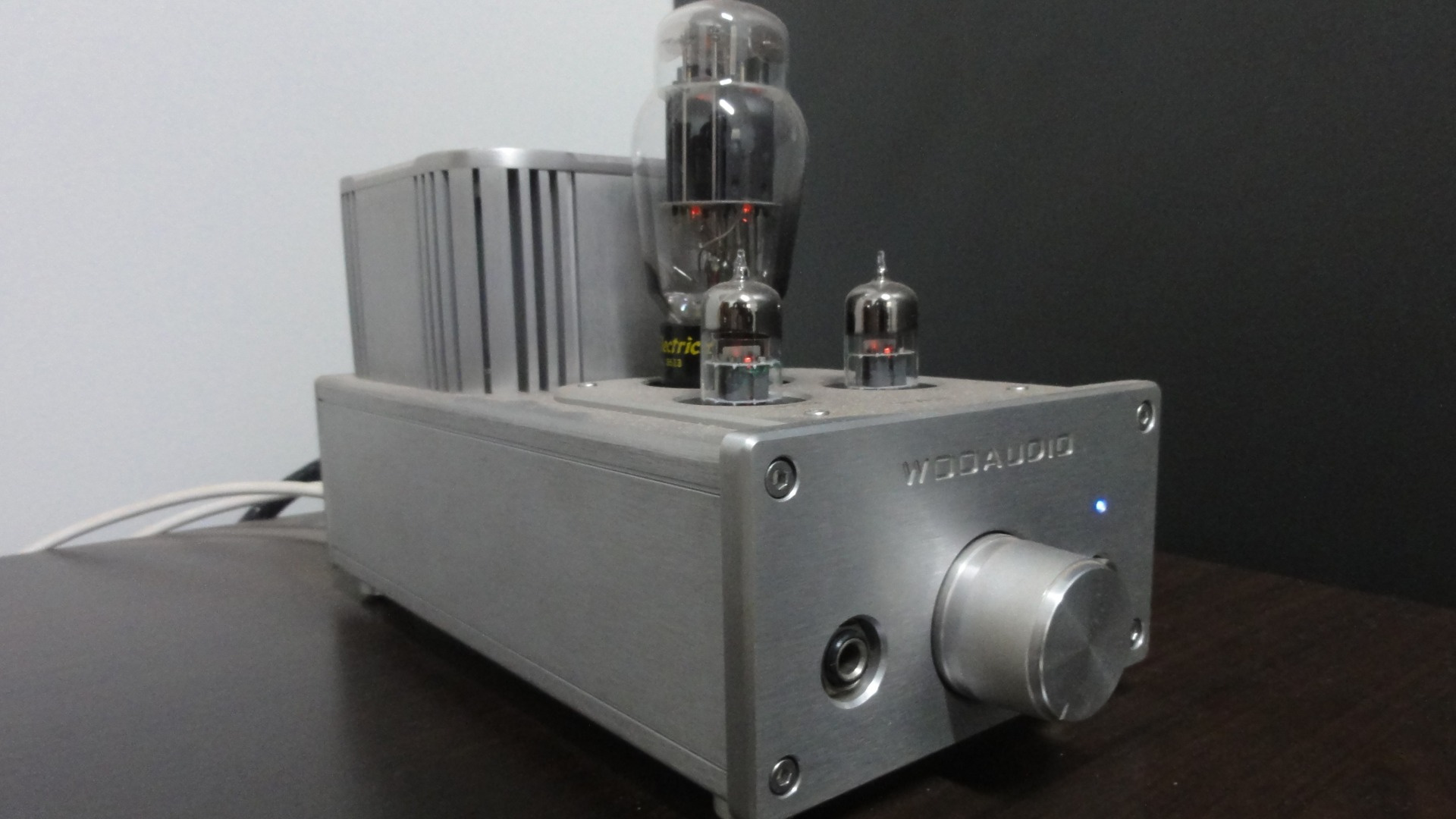 Illustrative image of a tube amplifier — pictured is the Woo Audio WA3 model (Image: Vitor Valeri/Hi-Fi Hub)
Tube amplifiers (amps) are often sought after for their reputation of delivering a more “organic” and “natural” sound. However, because there are several different types, depending on which one you purchase and the headphones used, the results can range from impractical to excellent. In this article, I discuss how each group of tube-based amplifiers operates, the differences among them, and which option is best suited for each scenario.
What characterizes a tube amplifier?
A tube amplifier is characterized by the use of thermionic valves, or vacuum tubes in English, which literally refers to a “vacuum tube.”
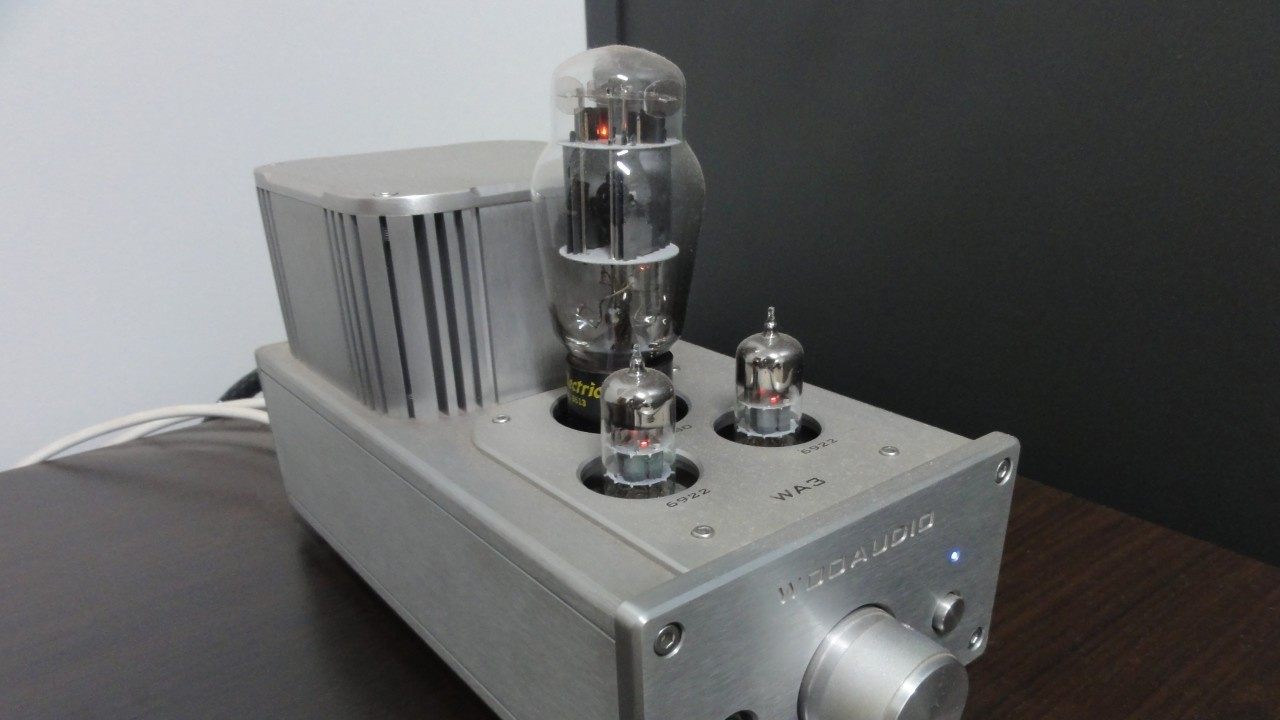
What are the tubes used in audio amplifiers?
The tubes traditionally used in audio amplifiers typically have a light-bulb-like shape.
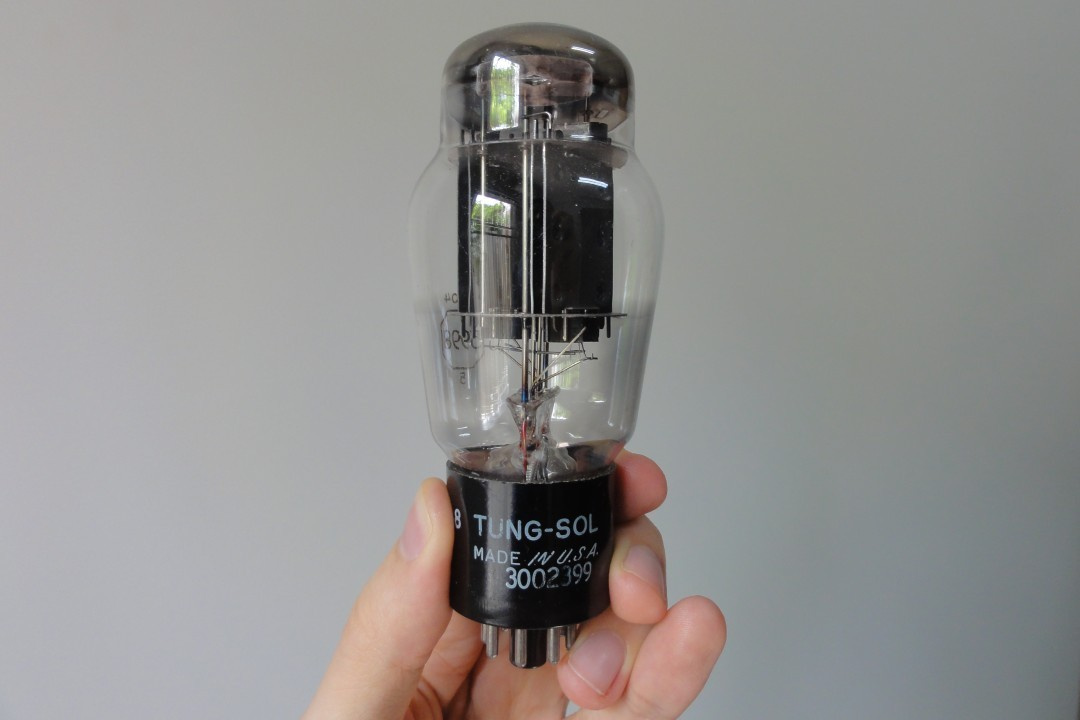
Inside the glass envelope there is a vacuum (no air) and internal components that allow amplification of an analog (electrical) line-level signal (for example, 2 V RMS) sent by a DAC (Digital-to-Analog Converter), a Digital Audio Player (DAP), or a preamplifier. These components include:
• Filament (heater): a metal wire, usually tungsten-coated, which, when heated to several hundred degrees Celsius, becomes incandescent (glowing) inside the tube. Its function is to heat the cathode.
• Cathode: there are two types of cathodes. The first is direct-heated (DHT), in which the cathode is the filament itself. The second is indirect-heated (IHC), in which a metal tube coated with emissive oxides contains a filament inside.
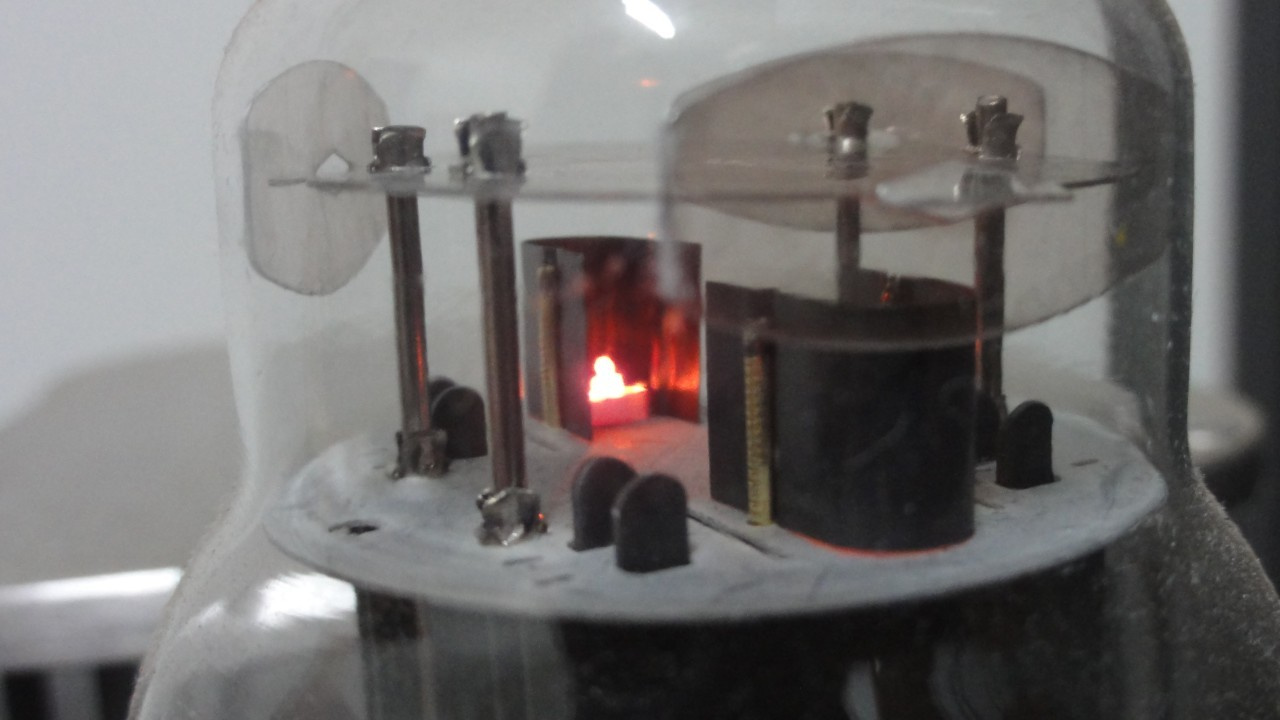
• Anode/plate: a metal plate that may be flat, cylindrical, or shaped like a “U,” “H,” or “C.” Its function is to attract the electrons emitted by the cathode, receiving the current and transferring it to the tube amplifier circuit.
• Grids: a tube may have one grid and be classified as a triode, two grids and be classified as a tetrode, or three grids and be classified as a pentode. The grids control the flow of electrons between the cathode and the anode (plate).
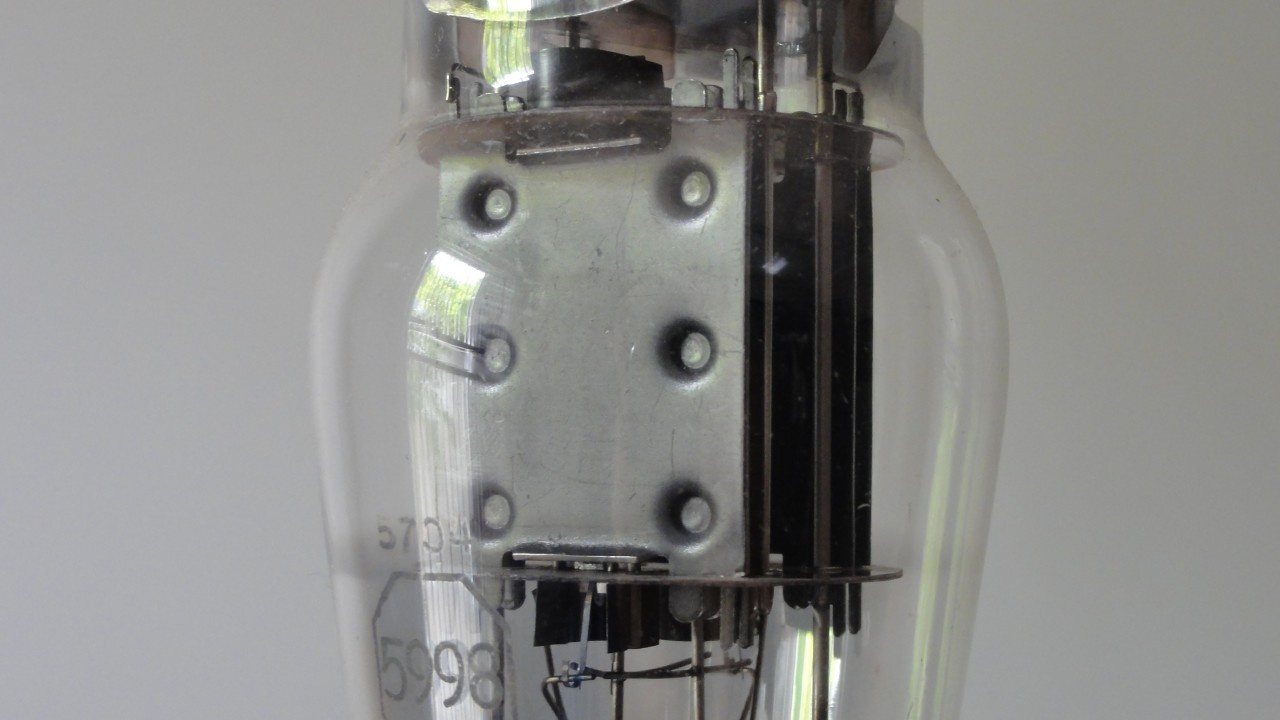
• Getter: a reactive metal element (e.g., barium, magnesium, zirconium), circular, square, or D-shaped, usually located at the top of the tube, though in some cases at the bottom. When the tube is heated, the getter releases vapor from these reactive metals, which deposits on the inner wall of the tube, forming the metallic “flash.”
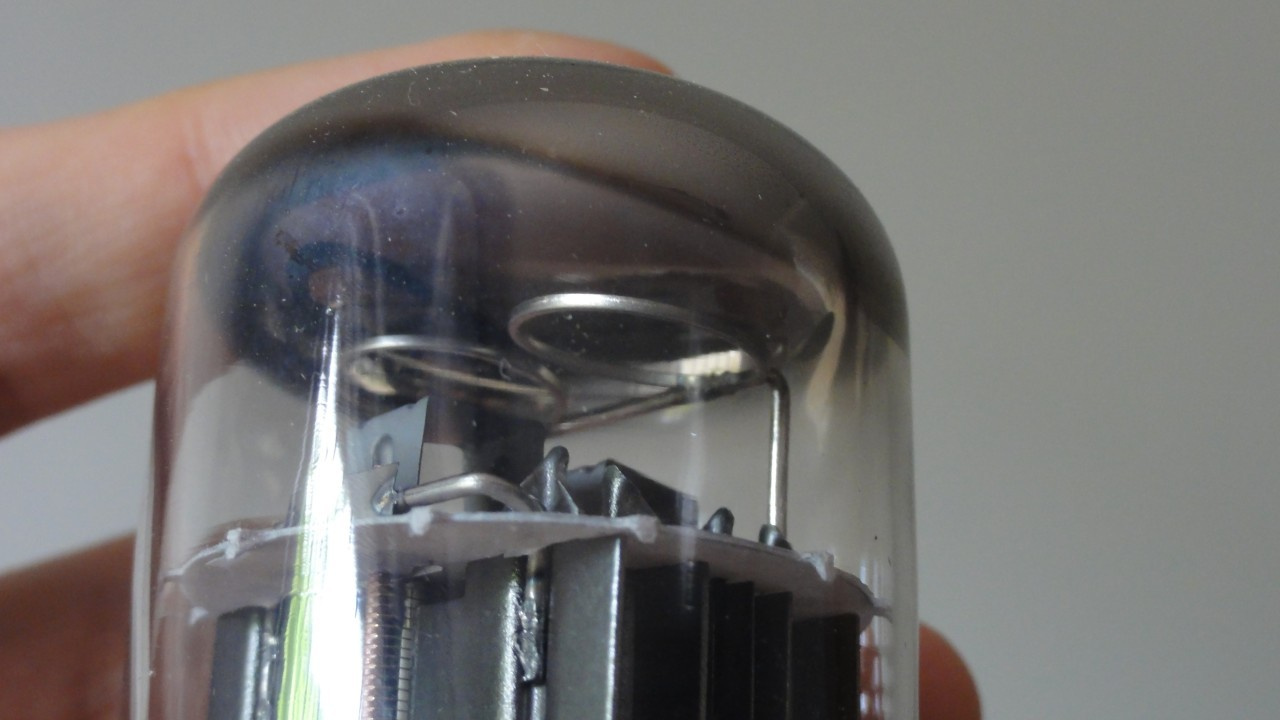
• Metallic flash: the silver or dark-gray patch usually found at the top of the tube (or at the bottom in some designs). It is formed by the deposition of vaporized metals that react with oxygen. When oxygen enters the tube, this patch turns white, indicating that the tube has failed.

• Supports and metal rods: structural elements that support the internal components of the tube, such as the cathode, anode (plate), and grids.
• Insulating spacers: circular components with multiple protrusions made of insulating material, used to maintain fixed distances between components, electrically isolate internal parts, and reduce vibration, microphonics, and noise. Typically, one is located at the top and another at the base of the tube.
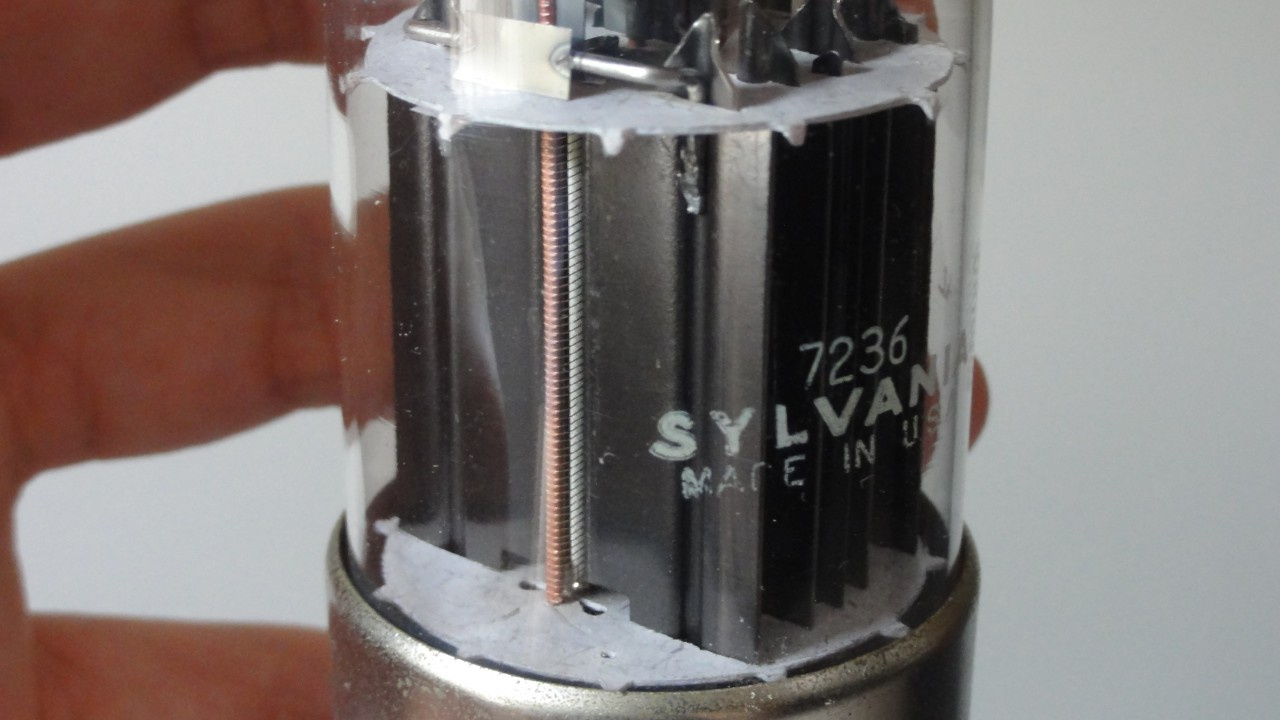
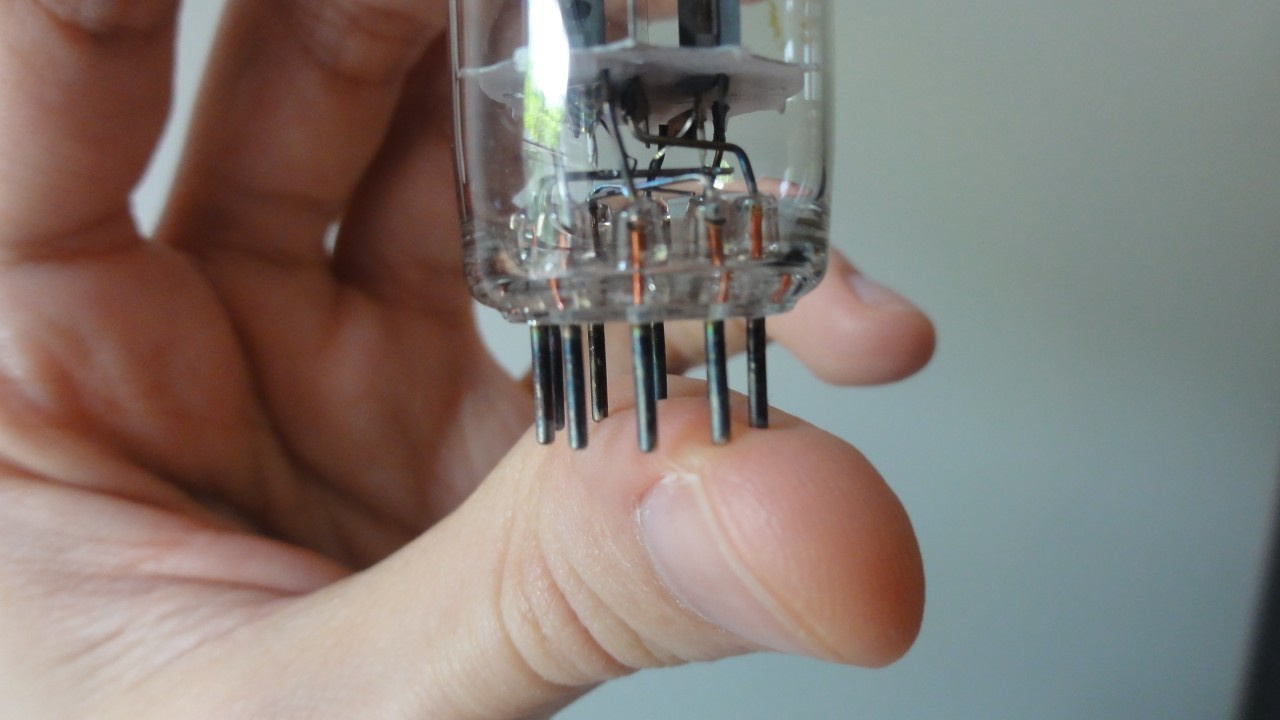
• Pins: used to secure the tube in its socket and electrically connect the tube to the amplifier circuit.
There are tubes that contain two triodes internally, such as the 6AS7G/6080, which are power tubes. A triode consists of:
• one cathode
• one anode (plate)
• one control grid
The only difference between a triode, a tetrode, and a pentode is the number of grids. All other basic components (cathode and anode) are the same.
What types of tube amplifiers exist?
There are three main types of tube amplifiers:
• Output transformer-coupled (OTC) tube amplifiers
• Output transformer-less (OTL) tube amplifiers
• Hybrid tube amplifiers (tubes in the input stage and transistors in the output stage)
However, in an effort to reduce costs, the Chinese market introduced one additional category:
• Low-voltage tube amplifiers
“Pure” tube amplifiers
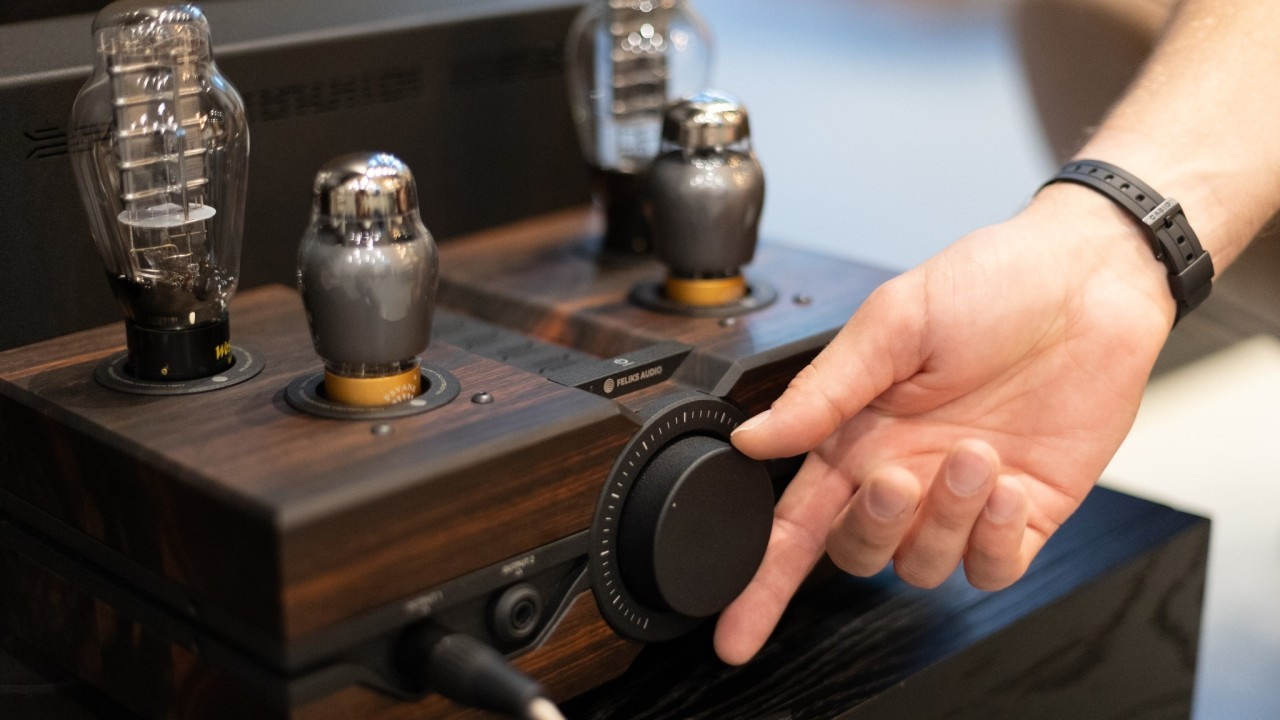
OTC and OTL tube amplifiers are considered “pure” because both the preamplification and power amplification stages are performed by tubes.
What is preamplification in tube amplifiers?
Preamplification in tube amplifiers increases the voltage of the incoming line-level signal (for example, 2 V RMS) received from a DAC, DAP, or preamplifier.
What is power amplification?
Power amplification in tube amplifiers occurs after preamplification and serves to increase the current, enabling the headphone diaphragm or loudspeaker driver to vibrate and produce sound.
What is the difference between an OTC and an OTL tube amplifier?
The differences between OTC and OTL tube amplifiers are primarily related to the presence or absence of an output transformer and an input capacitor. In OTC designs, there is no input capacitor, and an output transformer is used. In OTL designs, there is no output transformer, but a capacitor is employed instead.
The functions of the output capacitor in OTL amplifiers are:
• To filter direct current (DC), allowing only alternating current (AC) to pass
• To provide impedance matching between the tube and the connected headphones
• To define the amplifier’s low-frequency (bass) response
• To provide circuit stability, preventing low-frequency oscillation
The output transformer in OTC amplifiers serves to:
• Convert the tube’s impedance to a low impedance suitable for the load (connected headphones)
• Block DC, allowing only AC to pass
• Reduce the transmitted voltage
• Provide impedance matching with the connected headphones

Signal path in an OTC tube amplifier
In an OTC tube amplifier, the signal follows this path:
- Line-level signal enters via RCA or XLR inputs
- Preamplification, increasing signal voltage
- Power amplification, increasing signal current
- Output transformer (OT)
- Output to headphones or speakers
Signal path in an OTL tube amplifier
In an OTL tube amplifier, the signal passes through the following stages:
- Line-level signal enters via RCA or XLR inputs
- Input capacitor filters DC, allowing only AC to pass
- Preamplification, increasing signal voltage
- Power amplification, increasing signal current
- Filtering through a large output capacitor
- Output to headphones or speakers
Advantages and disadvantages of OTC and OTL amplifiers
OTC amplifiers can drive low-impedance headphones (32 ohms), such as models from Focal, Grado, Denon, and Fostex, as well as planar magnetic headphones from HiFiMAN, Meze, and Audeze. They are capable of delivering the required current without distortion.
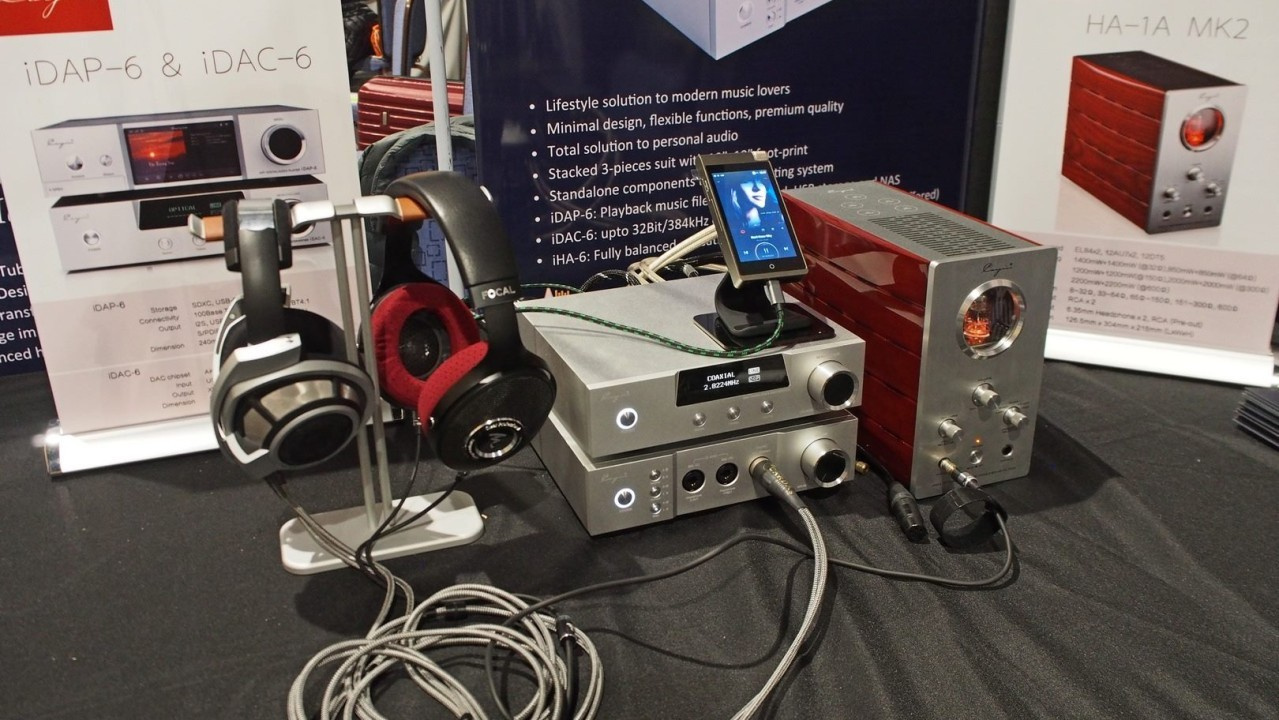
Examples of OTC tube amplifiers include the Woo Audio WA6, Feliks Audio Envy, and Cayin HA-1A MK2.
Examples of OTL tube amplifiers include the Little Dot MK II, DarkVoice 336SE, Bottlehead Crack, La Figaro 339SE, and Feliks Audio Echo.
Hybrid tube amplifiers
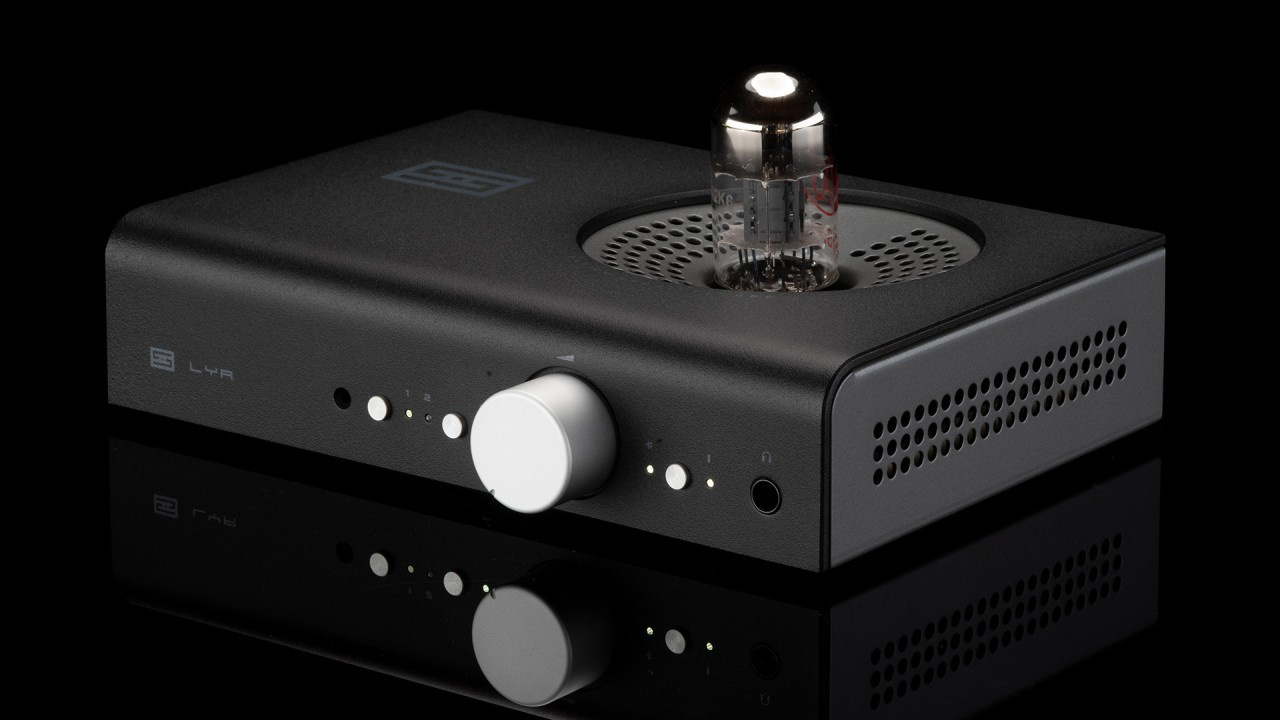
Hybrid tube amplifiers use tubes only in the preamplification stage to increase voltage from the line-level signal provided by a DAC, DAP, or preamplifier, while power amplification is handled by transistors.
Examples of hybrid amplifiers include the xDuoo TA-26s, xDuoo TA-10, xDuoo TA-20, Schiit Lyr+, Schiit Vali 2+, and Woo Audio WA7.
What types of transistors are used in hybrid tube amplifiers?
Hybrid tube amplifiers typically use MOSFETs (Metal-Oxide-Semiconductor Field-Effect Transistors) and BJTs (Bipolar Junction Transistors), though JFETs (Junction Field-Effect Transistors) can also be found.
JFETs are used in amplifiers designed to provide a more “tube-like” or “smooth” sound, while MOSFETs are employed in more powerful and stable amplifiers. The best measured performance is generally found in amplifiers using MOSFETs.
Low-voltage tube amplifiers
Low-voltage tube amplifiers were developed in an attempt to offer both preamplification and power amplification using tubes at a lower cost than OTL or OTC designs.
While OTL tube amplifiers typically operate at voltages between 80 V and 250 V, low-voltage tube amplifiers operate at much lower voltages, usually between 24 V and 60 V, which limits their ability to adequately drive high-impedance headphones.
The power tubes used in low-voltage designs are small compared to traditional power tubes, providing limited current to the headphones. In addition, the output capacitors are small, further restricting energy transfer to the load.
An example of a low-voltage tube amplifier is the Fosi GR70.

How do different types of tube amplifiers handle headphones with different impedances?
OTL amplifiers generally perform better with higher-impedance headphones (for example, 150 to 600 ohms), making them well suited for models such as the Sennheiser HD600/HD650/HD660S/HD800S, Beyerdynamic models rated at 250 and 600 ohms, and ZMF headphones. However, some OTL amplifiers can handle 32-ohm headphones; one example is the Woo Audio WA3, which can drive low-impedance dynamic headphones, though planar magnetic models do not perform well with it.
Tube amplifiers capable of handling both low- and high-impedance headphones include:
• OTC tube amplifiers
• Hybrid tube amplifiers
• Low-voltage tube amplifiers
Where is tube influence most pronounced?
The greatest influence of tubes is found in OTL amplifiers, as there is only a single capacitor regulating voltage before the headphone output. Next are OTC tube amplifiers. Finally, hybrid amplifiers exhibit the least tube influence, as tubes are used only in the preamplification stage to increase the voltage of the line-level signal from the DAC, DAP, or preamplifier.
Which types of tube amplifiers are the least expensive?
The most affordable tube amplifiers are hybrid designs, followed by low-voltage tube amplifiers. OTL and OTC tube amplifiers are more expensive than hybrid models. In general, OTC amplifiers tend to be more costly than OTL designs due to the use of an output transformer.
Which tube amplifier should you choose?
If you own low-impedance headphones (for example, 32 ohms or less), consider OTC tube amplifiers, hybrid tube amplifiers, or low-voltage tube amplifiers. If you plan to use high-impedance headphones, OTL tube amplifiers are worth considering.
Share:




No comments have been made yet, be the first!