

Cayin N6III (T201) DAP Is Officially Launched
From: Vitor Valeri
A headphone hobbyist for over 15 years, he founded the Hi-Fi Hub website and is an administrator of the "Fones High-End" and "Fones Low-End" groups on Facebook.


Published in: 19/12/25 at 20:46 - Updated in: 05/01/26 at 12:28
 Cayin N6III (T201) Digital Audio Player (DAP) (Image: Cayin/weibo)
The Cayin N6III Digital Audio Player (DAP) received a new version today (19) featuring the T201 motherboard, which uses a pair of Raytheon JAN6418 vacuum tubes. The most interesting aspect of the T201 is the implementation of a technology that allows users to extract three different sound signatures by adjusting how the DAP connects to the tubes. If you don’t like the sound, simply swap the board, as the N6III allows the motherboard to be replaced easily.
How does the N6III swap its motherboards?
Using a game cartridge–style connection system combined with side locking mechanisms, the N6III allows users to remove and install different motherboards. Each board features a different DAC and amplifier, enabling future upgrades or changes to the sound character.
According to Cayin, the motherboard swapping system works as follows:
“Each audio motherboard has an independent microcontroller responsible for managing audio configuration. Through serial communication, the main unit coordinates operations, allowing full control over audio settings.
This goes beyond upgrading only the analog headphone amplification stage, as it also includes the complete replacement of the DAC and analog circuitry.”
What does the new T201 motherboard bring?
According to Cayin, the T201 board uses a pair of carefully selected and tightly matched Raytheon JAN6418 vacuum tubes. If you’re not familiar with them, the JAN6418 tubes were originally released by Raytheon in the 1940s, which is why they are classified as NOS (New Old Stock)—units that were manufactured decades ago but never used.
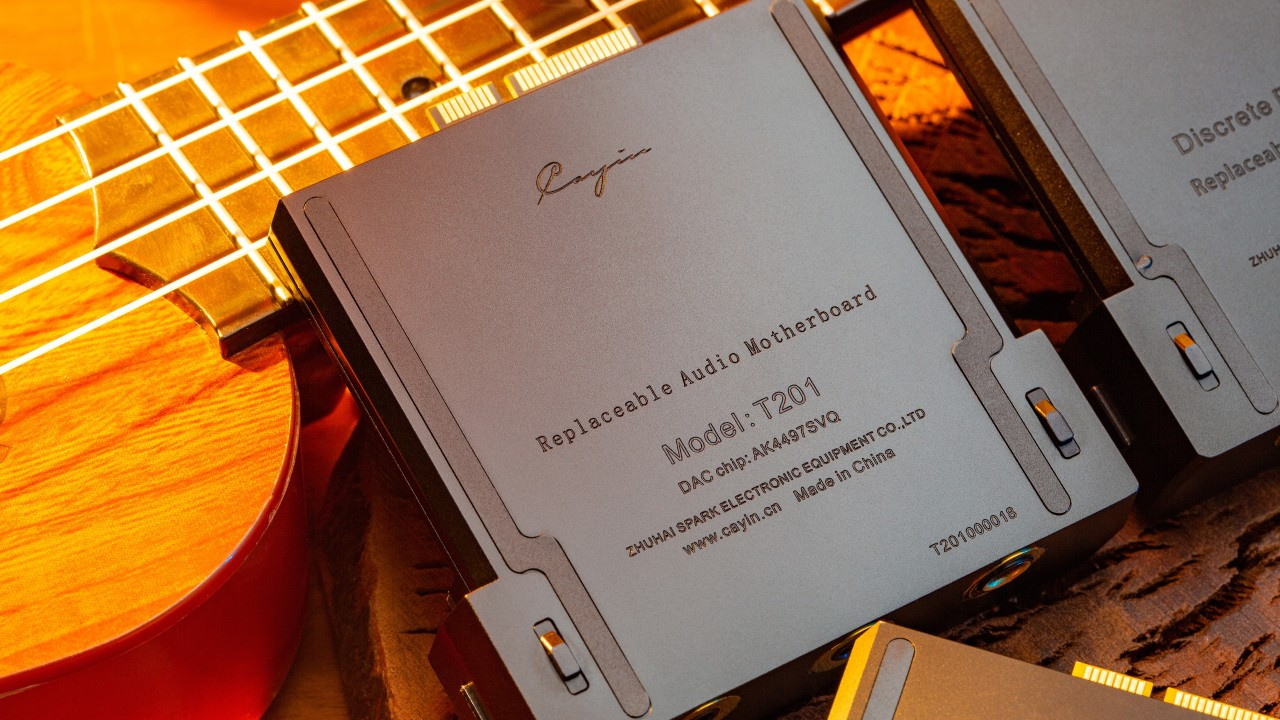
The JAN designation stands for “Joint Army Navy,” indicating that these tubes were developed for military use. This means their design prioritizes consistent measurements and greater durability, using materials that are more resistant to shock, vibration, and temperature extremes.
As subminiature tubes (also known as pencil tubes), the JAN6418 has a much smaller structure than traditional vacuum tubes, with extremely thin pins. As a result, they are soldered directly onto the board rather than socketed, making replacement more difficult—though still possible depending on the design.
Notably, the T201’s tubes can be used through both the 3.5 mm single-ended output and the 4.4 mm balanced output. In addition, users can select between headphone output (PO), line out (LO), or pre-amplifier output (PRE).
Three sound signatures using the same tubes
Cayin’s engineers implemented a “controllable local load design,” allowing adjustments to how the T201 board connects to the tubes. According to the company, this results in audible differences in sound characteristics, including frequency response, harmonic distortion, and dynamics.
Users can switch between three sound modes, described below:
• Vacuum Tube · Classic Mode: Warmer, fuller sound with rich harmonics and greater musicality.
• Vacuum Tube · Modern Mode: Cleaner, more balanced sound with improved control and lower distortion.
• Transistor Mode (Solid-State): More neutral and precise sound with high fidelity and excellent detail.
Anti-vibration system for the tubes
Cayin developed a dedicated enclosure for the pair of JAN6418 tubes that incorporates a silicone-based damping system. In addition, the chassis features an internal floating suspension structure, which helps absorb shocks and vibrations.
The DAC of the T201 board
For the T201 board, Cayin chose the AKM AK4497S DAC, which supports PCM up to 768 kHz and DSD512. The AK4497S also features an independent power supply circuit called “Advanced Routing,” which, according to the manufacturer, significantly reduces power supply noise.
Cayin N6III (T201): Specifications
Basic information
CPU: Snapdragon 665
Operating system: Android 12
DAC: AK4497SVQ
Battery: 3.85 V / 9000 mAh (34.65 Wh)
Display: 5″ TFT 1080 × 1920 (FHD)
Wi-Fi: IEEE 802.11 a/b/g/n/ac
Weight: 350 g (T201 motherboard weighs 60 g)
Dimensions: 126 × 77.8 × 23 mm
Battery life specifications
PO (headphone output)
3.5 mm single-ended:
• 17.7 h (solid-state mode)
• 15 h (tube mode)
4.4 mm balanced:
• 14.3 h (solid-state mode)
• 13.5 h (tube mode)
LO (line out)
• 3.5 mm single-ended: 18 h (solid-state mode)
• 4.4 mm balanced: 15 h (solid-state mode)
Audio specifications (solid-state mode)
3.5 mm headphone output (single-ended)
• Output power: 252 mW (32 Ω)
• Frequency response: 20 Hz – 20 kHz (±0.1 dB)
• THD+N: 0.009% (1 kHz, 32 Ω, A-weighted)
• Signal-to-noise ratio (SNR): 120 dB (A-weighted)
• Dynamic range: 120 dB (A-weighted)
• Channel separation: 80 dB (1 kHz, 32 Ω, A-weighted)
• Output impedance: 0.5 Ω (32 Ω)
4.4 mm headphone output (balanced)
• Output power: 543 mW (32 Ω)
• Frequency response: 20 Hz – 20 kHz (±0.1 dB)
• THD+N: 0.009% (32 Ω, A-weighted)
• Signal-to-noise ratio (SNR): 120 dB (A-weighted)
• Dynamic range: 120 dB (A-weighted)
• Channel separation: 120 dB (1 kHz, 32 Ω, A-weighted)
• Output impedance: 0.8 Ω (32 Ω)
Launch, price, and availability
The Cayin N6III (T201) was released in China on December 19, 2025 for 8,999 yuan (approximately US$1,278). The standalone Cayin T201 motherboard was released on January 5, 2026 for 3,499 yuan (around US$500).
Share:


Product launches
YBA VIBE P1: Portable R2R DAC/Amp Announced
Product launches
FiiO FT15 Launches With New Planar Driver and Lighter Build
Product launches
No comments have been made yet, be the first!